
Tower Rush Strategies: Bankroll Management and Cashout Timing
Tower Rush by Galaxsys is an instant game: either you hit cashout in time, or the tower falls and your bet is gone. No reels, no paylines. You climb level by level, the multiplier grows, and at some point you have to stop.
This guide looks at what actually influences the result here — and what is just a comfortable story people tell themselves after a loss.
Exclusive Tower Rush deposit bonus for new players

New players can triple their starting balance with an exclusive 200% bonus on their first deposit! This means you can boost your bankroll and take on Tower Rush with even more confidence and bigger bets. Don't miss out—claim your 200% deposit bonus today and stack your winnings higher than ever!
How Tower Rush Actually Works

Before thinking about any approach to the game, you need to understand one fact: the outcome of every round is determined before you press the button. Tower Rush runs on Provably Fair technology. The server generates the result in advance, hashes it and shows you the hash code before the round begins. Once it ends, the key is revealed — anyone can verify the result was not changed.
The tower climbing animation is just a visualisation of an already-decided result. No click timing, no patterns from past rounds affect the next outcome. Every round starts fresh.
Key Game Parameters
| Parameter | Value |
|---|---|
| RTP (return to player) | 96.17–97% |
| Maximum multiplier | x100 (x50 in some versions) |
| Developer | Galaxsys |
| Fairness system | Provably Fair |
| Volatility | Medium-High |
An RTP of 97% means the casino holds a mathematical edge of roughly 3% over the long run. No strategy removes that edge. But a sensible approach to bet sizing does influence how many rounds you play and how manageable your losses remain.
Bankroll Management: the Only Thing That Actually Works
Not the most exciting section. But this is where the decisions happen that separate a controlled session from one where the balance is gone in ten rounds.
Bet Size: No More Than 1–5% Per Round
With a balance of 100 units, bet between 1 and 5 units per round. That gives you at least 20 rounds even during a losing streak. With the more conservative 1% approach, you get 100 rounds. Sounds dull, but that buffer is exactly what lets you ride out normal variance without going bust at the very start.
Three Limits to Set Before You Play
- Loss limit — if you lose 40–50% of your session bankroll, stop.
- Profit target — if you reach, say, +50–100% of your starting amount, lock in the win and leave.
- Time limit — maximum playing time regardless of results.
All three limits need to be set before the session, not during it. In the heat of the moment, decisions are almost always worse than those made in advance.
Which Multiplier to Cash Out At
The most important decision in every Tower Rush round is at which multiplier to stop. There is no universally correct answer: it depends on how much you have in your bankroll and what level of loss you can comfortably absorb.
Early Cashout: x2–x5
You exit at the lower tower levels without waiting for high multipliers. The rate of successful rounds is noticeably higher, the payout per round is small. Works well for long sessions where keeping control of the bankroll matters. Not for players chasing a single big win.
Mid Range: x5–x15
Moderate risk with a meaningful payout when it works. The approximate probability of hitting x10 is around 10% — so on average one successful round in ten. Several consecutive losses in a row are normal here; being prepared for that beforehand helps.
High Multipliers: x10–x100
The chance of hitting x50 is about 2%, x100 about 1%. That means long losing runs with rare large payouts. With this approach keeping your bet size minimal is especially important, otherwise the bankroll runs out before the first big win arrives.
Probability by Multiplier Level
| Multiplier | Approximate chance of hitting | Risk level |
|---|---|---|
| x1.5 | ~65% | Low |
| x2 | ~48% | Low |
| x5 | ~19% | Medium |
| x10 | ~10% | Medium |
| x20 | ~5% | High |
| x50 | ~2% | High |
| x100 | ~1% | Extreme |
These figures are approximate and may vary by platform. The current RTP is best confirmed with the specific operator.
Auto-Cashout: Why Removing Yourself from the Equation Helps
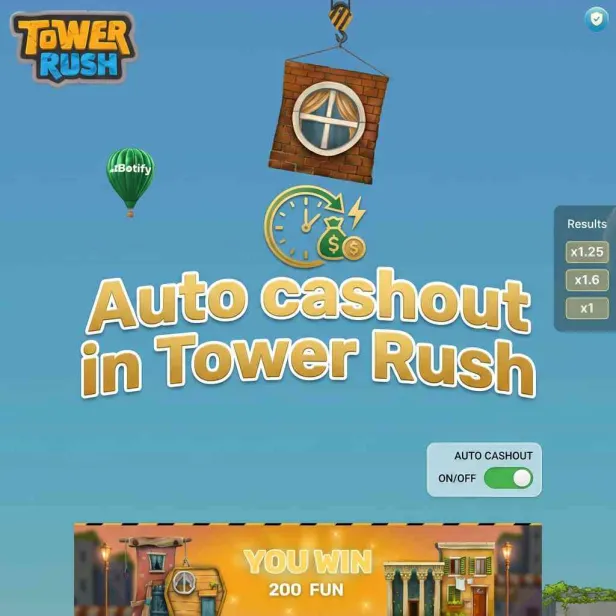
Many platforms let you set a target multiplier in advance, and the system locks in the win automatically when it is reached. A simple tool, but useful precisely because it removes the temptation to wait just a bit longer.
Before trying the free Tower Rush demo, it is worth picking your multiplier and setting auto-cashout: that way you practise a decision-making structure rather than improvising in the moment.
The main downside of auto-cashout is a lack of flexibility. In rare cases where you want to react to a specific round, the feature won't allow it. Most experienced players still prefer it to manual mode: not because it is smarter, but because it is more consistent.
Mistakes That Cost Money
Most losses in Tower Rush do not come from bad luck but from concrete decisions made at concrete moments.
- Chasing losses. Raising the bet after a losing streak to recover quickly does not change the game's mathematics. It does empty the bankroll fast.
- Playing without limits. Starting a session without a pre-set loss threshold means deciding on the fly, which is always worse.
- Bets that are too large. A bet of 10–20% of the bankroll per round means going to zero in five to ten attempts during a normal variance run.
- Believing in patterns. The tower hasn't fallen for a while so it'll hold now — doesn't work. Every round is independent; past results say nothing about the next one.
- Playing in the wrong state. Tiredness, stress, excitement after a big win or loss — decisions made in that state are worse, that's simply a fact.
Psychology: Why Discipline Matters More Than Any Tactic

Tower Rush has simple rules but high emotional pressure. After every successful level, the same dilemma: stop now or risk going further? This is exactly where most players end up losing more than planned.
A few things that genuinely help:
- Write down the plan before starting: bet size, target multiplier, limits. Don't rely on memory.
- After three or four consecutive losses, take a break of at least ten minutes.
- Use the mobile app if it has reminders or time limits built in.
- Keep a simple session log: when you played, how much you started with, how much you finished with. Numbers clear out illusions quickly.
Tilt — the state where decisions are driven by emotion — is just as dangerous after a losing run as it is after a big win. It is hard to spot in yourself, but that ability is exactly what separates those who walk away from a session with a controlled loss from those who lose their entire balance.
Demo Mode: How to Actually Use It
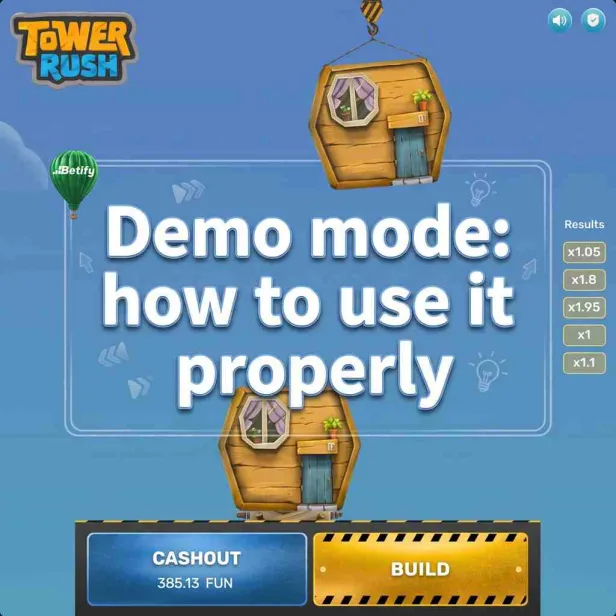
Most people treat demo mode as a way to try the game. That's fair, but it's not the full picture. The demo is a good opportunity to test a specific approach without financial risk: set auto-cashout to your chosen multiplier and watch how you react to a run of bad rounds.
A few questions worth answering after a few demo sessions:
- Is the chosen multiplier psychologically comfortable when five or six losses come in a row?
- Does the auto-cashout behave as expected?
- Does the game pace match how long you actually want to play per session?
If after several demo sessions everything still feels manageable, move to real money — starting with minimum bets.
Responsible Gambling: Not a Checkbox Section
No playing approach turns Tower Rush into a reliable income stream. The casino's mathematical edge remains whatever multiplier you choose.
If the game starts taking more time or money than planned, or the urge to keep going to recover losses appears, that is a signal to seek support. GamCare and GambleAware offer confidential help. Looking at other players' experiences can also be worthwhile: sometimes others' mistakes explain things better than any guide.
Tower Rush: What a Strategy Does and Does Not Do
A strategy in Tower Rush does not help you win more often. It helps you avoid losing more than you planned. These are different things, and confusing them costs money.
Provably Fair guarantees results are verifiable and every round begins independently. That means the next outcome cannot be predicted. What can be done is consistently sticking to the chosen bet size, the pre-set target multiplier and session limits — and walking away with a clear result instead of regrets.
If you are just getting started with Tower Rush: open the demo, pick one approach, set your limits. Then see how it plays out in practice.
Frequently Asked Questions about Tower Rush Strategies
Does the moment I click cashout affect the round result?
No. The result of every Tower Rush round is determined by the Provably Fair algorithm before the round begins. The tower animation is simply a visualisation of the pre-set result, so click timing has no effect on the outcome.
What bet size is considered safe for a new player?
Experienced players recommend betting no more than 1–5% of your session bankroll per round. With a balance of 100 units that is 1–5 units per round — enough for 20–100 rounds even during a losing streak.
Do betting systems like Martingale work in Tower Rush?
No. Martingale and similar systems do not change the casino mathematical edge. During long losing runs they require exponentially growing bets, which drains the bankroll quickly.
Can you predict which level the tower will collapse at?
No. Each round result is generated randomly and independently of previous rounds. Claims about predictable patterns have no mathematical basis.
What is auto-cashout and is it worth using?
Auto-cashout is a feature where the system automatically secures your win when a set multiplier is reached. It helps maintain your strategy and avoid impulsive decisions. Many players prefer it to manual mode specifically for the discipline it enforces.
Does demo mode help with learning strategies?
Yes. Demo mode lets you test your chosen target multiplier and auto-cashout without financial risk, get a feel for the game pace and confirm your approach feels comfortable before moving to real money.
